

A partial pay installment agreement is an IRS payment plan that ends before your balance does. You make an affordable monthly payment for a set period, and when the IRS’s time limit to collect expires, it generally can’t collect any remaining balance. For the churches, nonprofits, and closely held businesses we work with across Southern California, this is often the option worth understanding before accepting a standard payment plan that may not fit the budget.
Shaun Glenn, CPA, MSA, MST, reviews these agreements for individuals, pastors, and business owners who want a plan that reflects what they can actually afford, not just what the IRS first proposes. Here is what a partial payment installment agreement involves, who typically qualifies, and where it fits alongside other IRS resolution options.
What Is a Partial Pay Installment Agreement?
A partial pay installment agreement, often shortened to PPIA, is an IRS installment agreement that doesn’t require you to pay your full tax debt. Instead, you pay a monthly amount based on what the IRS determines you can afford, for as long as the collection statute allows.
The IRS gained the authority to approve partial-payment agreements in 2004, when Congress amended the tax code to let the agency accept agreements for “full or partial” collection of a debt. Before that change, every installment agreement required payment of the balance in full. That authority sits in the Internal Revenue Code and is carried out under the Internal Revenue Manual’s collection procedures.
A PPIA is different from a standard IRS payment plan in one key respect: it is built around the Collection Statute Expiration Date (CSED), which is the date the IRS loses its legal authority to collect a given tax debt. Because a PPIA payment amount is set low enough that the full balance will not be paid off before that date, part of the debt is addressed by the passage of time rather than full repayment.
How a Partial Pay Installment Agreement Works

The CSED is generally ten years from the date a tax is assessed, not from the date the return was filed or the date the debt became overdue. Each tax year carries its own CSED, so someone with several years of unfiled or unpaid taxes is actually working with several separate clocks.
Here is a simplified illustration of how the math can play out. These are examples only, not predictions, since every case depends on income, expenses, and how much time is left on the statute.
Scenario | Balance owed | Time left on the CSED | Monthly payment | Approximate total paid |
Smaller balance, more time left | $25,000 | 7 years | $150 | About $12,600 |
Larger balance, moderate time left | $60,000 | 4 years | $250 | About $12,000 |
Payment raised at the two-year review | $60,000 | 6 years | $200 for 2 years, then $450 | About $26,400 |
Certain events can pause the CSED clock and push it later, including an open bankruptcy case, time spent living outside the country, or a pending collection due process hearing. We pull the actual assessment dates from an IRS account transcript before estimating how a PPIA would run for a specific situation, because a rough ten-year estimate is rarely exact once those events are factored in.
It is worth noting that a PPIA already in place does not extend the CSED. A pending request for one can briefly pause the clock while the IRS is barred from levying, but once the agreement is active, the clock keeps running. That is the entire mechanism that makes a PPIA work.
Who Qualifies for a Partial Pay Installment Agreement
A PPIA generally comes down to two conditions: you cannot pay the full balance before the CSED runs out, and you can still pay something every month. Beyond that baseline, the IRS looks at a few specific factors.
- You have filed every tax return you are required to file, and you are current on estimated payments or payroll deposits going forward.
- You are not currently in an open bankruptcy case.
- The tax periods in question were not already settled through an accepted Offer in Compromise.
- You do not have accessible equity in assets that could reasonably be sold or borrowed against to pay the debt instead.
- A full Collection Information Statement, usually Form 433-A for individuals or Form 433-B for businesses, supports your request.
One common misconception is that a PPIA requires a minimum balance of $10,000. That figure actually comes from a different program, the guaranteed installment agreement, which has its own eligibility ceiling. There is no official minimum for a PPIA itself. In practice, a PPIA’s financial disclosure requirements make it impractical for very small balances, which is likely why the $10,000 figure became a rule of thumb.
How the IRS Calculates Your Monthly Payment

The IRS doesn’t ask what you want to pay. It calculates your allowable monthly payment using its own Collection Financial Standards, which set national and local expense allowances for categories like food, housing, transportation, and out-of-pocket health care.
If your actual housing or vehicle expense exceeds the local standard for your county, the IRS generally credits only the standard amount and counts the difference as available for your payment. The same applies to other categories. This is one of the most frustrating parts of the process for business owners and families whose real costs don’t match the government’s averages, and it is usually where a well-documented, organized financial statement makes the biggest difference.
Your disposable income, meaning what is left after the IRS’s allowable expenses are subtracted from your income, becomes your proposed monthly PPIA payment.
What Happens at the Two-Year Review
Unlike a standard installment agreement, the IRS must review a PPIA at least once every two years. The IRS sends a notice requesting updated financial information, and your case is reassigned for review based on that information.
The review can result in one of several outcomes:
- Your payment stays the same because your financial picture hasn’t changed meaningfully.
- Your payment increases because your income has gone up or your expenses have gone down.
- Your payment decreases if your situation has gotten harder, not easier.
- The IRS determines you can now pay in full and asks you to do so.
Missing the deadline to respond to a two-year review notice can put the entire agreement into default, which restores the IRS’s full collection powers, including levies. This is the step people are most likely to overlook once a PPIA has been running quietly in the background for a year or two, and it is one of the reasons we recommend ongoing bookkeeping support for anyone managing a multi-year resolution case.
What a Partial Pay Installment Agreement Costs
The IRS charges a setup fee based on how you apply and pay, separate from the monthly payment.
How you apply | Payment method | Setup fee |
Online | Direct debit | $29 |
Online | Other payment method | $69 |
Phone, mail, or in person | Direct debit | $107 |
Phone, mail, or in person | Other payment method | $178 |
Low income, any channel | Direct debit | Waived |
Low income, any channel | Other payment method | $43, often reimbursable |
Because a PPIA requires a full financial disclosure rather than a quick online request, most are set up by phone, mail, or in person, which puts the fee closer to the higher end of that range. Taxpayers who qualify as low income can apply for a reduced or waived fee using Form 13844.
The setup fee is the smallest number in this entire process. Failure-to-pay penalties and interest continue to accrue on the unpaid balance for as long as the agreement runs, which is why the amount eventually addressed through the CSED is usually larger than the original balance.
How to Apply for a Partial Pay Installment Agreement
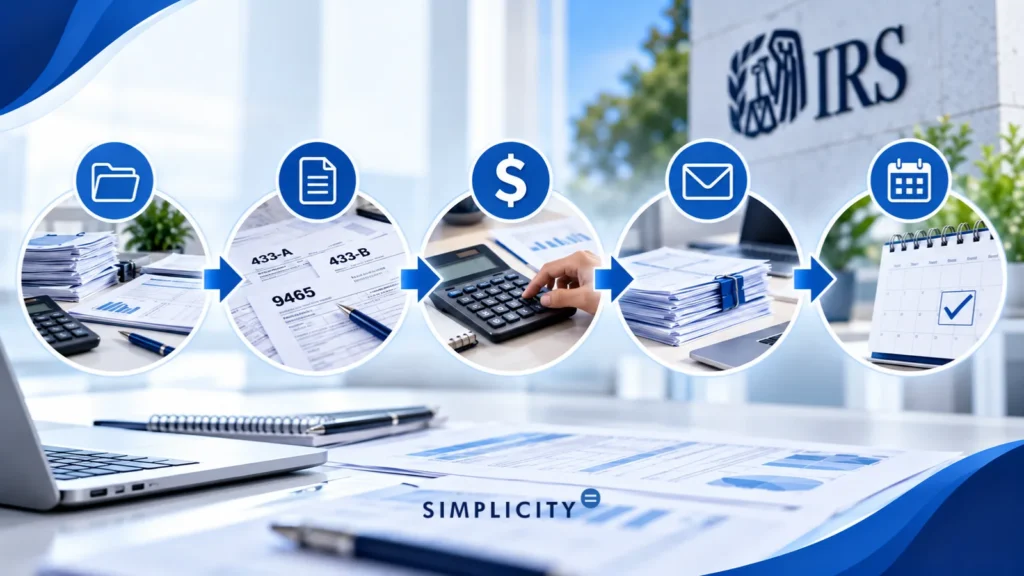
Applying for a PPIA involves more documentation than a standard online payment plan request. The general process looks like this:
- Gather your financial records: Recent pay stubs, bank statements, proof of assets, and a clear picture of monthly household or business expenses. A CPA can tell you upfront exactly which records the IRS will ask for, so you don’t have to scramble to find something mid-review.
- Complete the Collection Information Statement: Form 433-A for individuals or Form 433-B for businesses, along with Form 9465 if you are requesting the agreement in writing. A CPA who prepares these regularly knows where taxpayers typically under-document allowable expenses, which directly affects the payment the IRS proposes.
- Propose a monthly payment supported by your numbers: The amount needs to reflect the IRS’s own expense standards, documented where your actual costs run higher. A CPA can build that supporting documentation before the IRS can default you to the lower standard amount.
- Submit the request and handle follow-up: PPIA cases generally require more review than a standard streamlined agreement and aren’t typically processed through the IRS’s online self-service tool. A CPA can handle that follow-up directly, so you won’t have to explain your finances to a revenue officer over the phone.
- Stay current once approved: File every return on time, make estimated payments or payroll deposits as required, and respond promptly to any two-year review notice. A CPA can track that review date for you, so you don’t miss a letter that could quietly put the agreement into default.
A rejected PPIA request can be appealed to the IRS Independent Office of Appeals within 30 days, and the IRS generally cannot levy while that appeal is pending. A CPA can handle that appeal directly, so you don’t have to navigate it alone.
How Simplicity Financial’s CPA Credentials Change Your PPIA Case
A partial payment installment agreement lives or dies on the numbers in your Collection Information Statement, and that is exactly where a CPA earns their fee. Shaun Glenn, CPA, MSA, MST, has spent more than 15 years focused specifically on nonprofit and church finance, so the fund accounting, clergy compensation, and multi-campus payroll structures that complicate many Southern California cases aren’t a learning curve for us. We build your 433-A or 433-B from real bookkeeping records, not a rough estimate, and we know where the IRS’s standard expense allowances fall short of what a church, school, or closely held business actually spends. That distinction, backed by a licensed CPA in California rather than a call center or a commission-based negotiator, separates a PPIA case that gets approved at a workable number from one that gets rejected or defaulted on two years later.
Talk to a CPA Before You Propose a Number to the IRS
If you are not sure whether a partial payment installment agreement, a standard IRS payment plan, or another resolution option fits your situation, the next step is a conversation, not a guess. Simplicity Financial’s tax resolution services start with a review of your numbers, not a sales pitch, so schedule a phone call or book a Zoom call, and we will outline your options before you send the IRS anything.
FAQs About Partial Payment Installment Agreements
Is there a minimum tax debt required for a partial payment installment agreement?
No official minimum exists in the underlying rule, though the financial disclosure a PPIA requires generally makes it impractical for very small balances. The $10,000 figure some sites cite actually applies to a different, unrelated IRS program.
Does a partial payment installment agreement forgive my tax debt?
No single provision “forgives” a tax debt outright. A PPIA simply sets a monthly payment that may not fully pay off the balance before the IRS’s legal authority to collect it expires. Whether any balance becomes uncollectible then depends entirely on your individual case.
Can the IRS increase my payment during a partial payment installment agreement?
Yes. The IRS reviews your financial situation at least once every two years and can raise your payment if your income has increased or your expenses have decreased.
Is a partial payment installment agreement better than an Offer in Compromise?
It depends on your situation. An Offer in Compromise can offer more finality if your income is unlikely to improve, while a PPIA can make more sense if you expect your financial situation to stay roughly the same for years to come. A CPA can review your numbers and recommend the option that fits your situation.
What happens if I miss a payment on my partial payment installment agreement?
A missed payment, an unfiled return, or a new tax balance can put the agreement into default, which restores the IRS’s full collection powers.
Disclaimer: This article is educational information about how the IRS partial payment installment agreement program generally works. It is not individualized tax or legal advice, and reading it does not create a client relationship with Simplicity Financial. Tax outcomes depend on your specific facts, and IRS rules, fees, and financial standards change over time. Consult a licensed CPA before applying for a PPIA or any other IRS resolution option.