

Reasonable collection potential (RCP) is the formula the IRS uses to decide the lowest amount it will accept to settle a tax debt through an Offer in Compromise. It adds what the IRS believes it can collect from your assets and future income, and that total becomes the floor for any offer you submit. If your offer is below your RCP, the IRS has little reason to accept it.
Taxpayers who skip this calculation, or get it wrong, tend to end up in one of two places: an offer that gets rejected outright, or an offer that gets accepted for more than the IRS was actually entitled to collect. Here is what the formula includes, what the IRS expects you to document, and why a church, nonprofit, or small business owner working through tax debt in Southern California should care.
What Is Reasonable Collection Potential?
RCP is the number the IRS calculates under Internal Revenue Code Section 7122, the statute that allows the agency to compromise a tax liability. IRS Tax Topic 204 lays out the standard: if your offer equals or exceeds your RCP, the IRS will generally accept it as full payment of what you owe.
The simple version is this. The IRS wants to collect as much as it reasonably can, as fast as it reasonably can. RCP determines what “reasonable” looks like for your specific situation. That number comes from your income, your allowable expenses, and the equity in what you own, not from what you feel you can afford to pay.
This calculation applies specifically to the Offer in Compromise path. If you are weighing an offer against other IRS Fresh Start options, it helps to know that RCP is the math underneath this particular one. For the broader picture of how the program works, the Fresh Start program overview is a good place to start.
The Two Parts of the RCP Formula
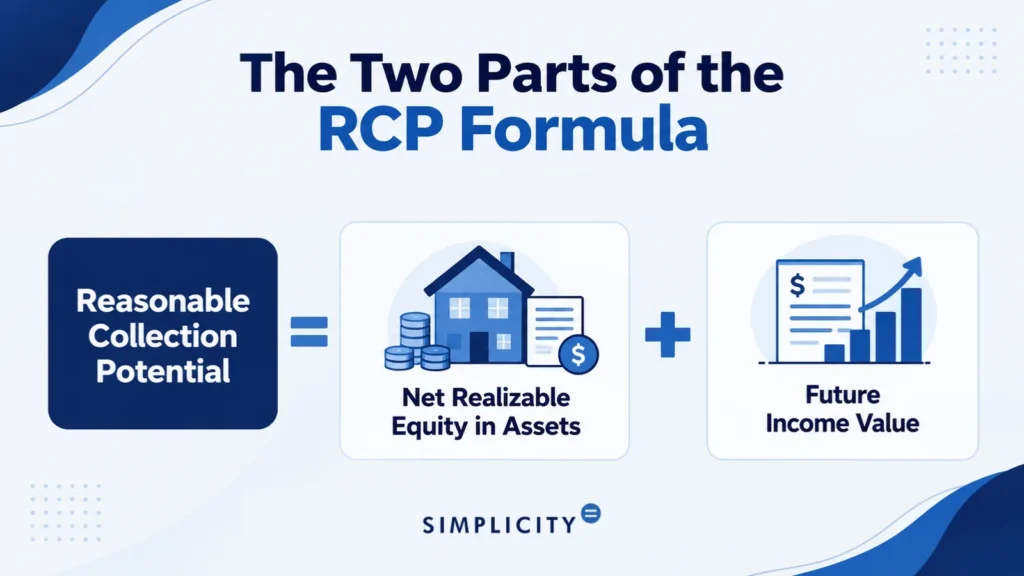
RCP has two components, and the IRS adds them together:
- Reasonable Collection Potential = Net Realizable Equity in Assets + Future Income Value
Each side of that equation has its own rules.
Net Realizable Equity in Your Assets
The IRS does not value your assets at what you think they are worth. It uses quick sale value, generally 80 percent of fair market value, to account for what a forced or fast sale would actually bring in. From that number, the IRS subtracts any debt secured against the asset.
For example, a $200,000 home has a quick sale value of $160,000. If $150,000 is still owed on the mortgage, the home’s net realizable equity is $10,000.
The IRS applies this same approach to bank accounts, vehicles, retirement accounts, investments, and business assets like equipment or receivables. Cash and cash equivalents are generally counted at full value, with no quick sale discount applied.
The IRS also looks backward, not just at what you currently hold. If assets were sold, transferred, or withdrawn in the period leading up to an offer, the IRS may add the value of those dissipated assets back into the equity calculation, even though you no longer hold them. A single prior transfer is not automatically a problem, but it is a factor a CPA should review before any offer is filed.
Future Income Value
The second half of the formula looks at what you earn, minus what the IRS allows you to spend. That difference is your monthly disposable income, and the IRS multiplies it by a set number of months depending on how you plan to pay:
- Lump sum offer: paid within 5 months of acceptance, monthly disposable income multiplied by 12
- Periodic payment offer: paid over 6 to 24 months, monthly disposable income multiplied by 24
A taxpayer with $300 in monthly disposable income would add $3,600 to a lump-sum offer or $7,200 to a periodic-payment offer. The payment structure you choose changes the total, which is why you decide it early in the process rather than as an afterthought.
What Counts as an Allowable Expense?
This is where most RCP calculations go wrong. Disposable income is not actual take-home pay minus actual bills. It is income minus what the IRS defines as an allowable expense, and the two figures are often different.
The IRS groups allowable expenses into a few categories:
- National Standards: fixed monthly amounts for food, clothing, personal care, and miscellaneous costs, the same nationwide regardless of what you actually spend
- Local Standards: housing, utilities, and transportation, which vary by county and are generally limited to the lesser of the standard or your actual cost
- Out-of-pocket health care: a per-person monthly allowance, separate from health insurance premiums
- Actual and conditional expenses: items such as minimum payments on secured debt, court-ordered support, or documented costs tied to your health or your ability to earn income
The IRS updates these dollar amounts on its Collection Financial Standards page, typically once a year, so the figures that applied to a return filed two years ago may not apply today. The right numbers for your household depend on your family size, your county, and the date your financial statement is prepared. Don’t estimate this from memory.
What You Will Need to Document

An Offer in Compromise is built on IRS Form 656, along with Form 433-A for individuals or Form 433-B for businesses. Those forms ask for a full financial statement, not a summary, and the RCP calculation is only as accurate as the documentation behind it.
That generally means recent pay stubs or profit and loss statements, bank and investment statements, vehicle and property valuations, and records of any secured debt against those assets. For a closely held business or a church with multi-campus payroll, it also means current bookkeeping, since the IRS will question numbers that don’t reconcile with bank records. The financial statement behind an offer is a sworn disclosure, so accuracy matters as much as completeness.
A Simple Example of How RCP Works
A small business owner owes $85,000 in back taxes. She has $12,000 in net realizable equity across a vehicle and a modest investment account, and $250 a month in disposable income after allowable expenses.
If she proposes a lump-sum offer, her RCP is $12,000 plus 12 months of $250, or $15,000. If she proposes a periodic payment offer over 24 months, her RCP is $12,000 plus $6,000, or $18,000.
Either way, an offer in that range reflects what the IRS believes it can actually collect from her, not the full $85,000 she owes. That gap between RCP and the total balance is the entire basis for an Offer in Compromise. It is not a starting point for negotiation. The IRS checks this calculation against its own numbers before it accepts or rejects anything.
Why the RCP Calculation Trips Up So Many Taxpayers
Two mistakes show up again and again:
- An offer rejected at full balance: This happens when allowable expenses are understated, assets are valued at fair market value instead of quick sale value, dissipated assets are missed, or the IRS uses gross income instead of net. The IRS runs its own RCP calculation on every offer it receives. If its number is higher than yours, the offer is denied, and months of the collection statute have been spent on a submission that never had a real chance.
- An offer accepted for more than it needed to be: This happens when the correct national and local standards aren’t applied, or when conditional expenses that should have reduced disposable income are left off the financial statement. The IRS does not flag this. It simply accepts the offer as submitted, and the taxpayer pays more than the formula required.
According to the IRS Data Book for fiscal year 2025, the agency received 38,797 Offers in Compromise and accepted 5,464, an acceptance rate of about 14 percent. That figure reflects every offer the IRS received that year, not just those based on an accurate RCP calculation. It is a reasonable reminder that the math has to hold up before the paperwork does.
How Simplicity Financial Can Help

Simplicity Financial is led by Shaun Glenn, CPA, MSA, MST, who has spent more than 15 years focused exclusively on nonprofit and church finance, including fund accounting, Form 990 preparation, clergy compensation, and multi-campus church payroll. That depth matters because an RCP calculation is only as accurate as the financial statement behind it, and a generic resolution company is less likely to read a church’s restricted funds, a nonprofit’s board reporting, or a closely held business’s books correctly.
Before recommending an Offer in Compromise to any client, Shaun completes a full RCP review: current income, allowable expenses under the Collection Financial Standards, and the net realizable equity in every asset that factors into the formula. If the numbers support an offer, he builds the submission around them. If they do not, he says so directly and outlines what fits instead, whether that is an installment agreement or Currently Not Collectible status.
As a licensed CPA in California, Shaun is also bound by Treasury Department Circular 230, which governs what a practitioner can represent to the IRS and to a client. That professional standard, not a sales script, is why this firm reviews the full financial picture before filing anything, and why you should evaluate any firm offering tax resolution services before you sign on.
Get Your Numbers Reviewed Before You File
An Offer in Compromise lives or dies on the RCP calculation behind it, and that is not a number to estimate on your own before sending a sworn financial statement to the IRS. If you want a CPA to review your income, expenses, and asset equity before you file anything, schedule a phone call or book a Zoom call with Shaun Glenn, and he will walk through your numbers and outline the options that actually fit your situation.
Frequently Asked Questions
What is reasonable collection potential?
Reasonable collection potential is the IRS’s calculation of the most it can realistically collect from a taxpayer, combining net realizable equity in assets with a set number of months of future disposable income. Under Tax Topic 204, the IRS generally will not accept an Offer in Compromise for less than this amount.
How is RCP different from the amount I owe?
The amount you owe is your full tax liability, including penalties and interest. RCP is a separate calculation of what the IRS believes it can collect from your current income and assets. An Offer in Compromise settles the full liability for an amount close to your RCP, which is often well below the total balance.
What is the difference between the 12-month and 24-month multiplier?
The IRS multiplies monthly disposable income by 12 for a lump-sum offer paid within 5 months of acceptance, or by 24 for a periodic-payment offer paid over 6 to 24 months. The multiplier comes from the Form 656-B worksheet instructions, not from an informal rule of thumb.
What if my RCP is close to what I owe?
If RCP is close to the total liability, an Offer in Compromise usually is not the right tool, since the IRS has little reason to accept an offer that does not meaningfully reduce what it expects to collect. An installment agreement or Currently Not Collectible status often fits better. A CPA can review the numbers and point you toward the option that matches your actual finances.
Do I need a CPA to calculate my RCP?
Nothing requires it, but the IRS runs its own RCP calculation on every offer and compares it to yours. A CPA who understands the Collection Financial Standards, quick sale value, and allowable expense rules reviews the same numbers the IRS will check, reducing the chance of an offer that gets rejected or accepted for more than it needs to be.
Disclaimer: This article explains how the IRS calculates reasonable collection potential for general informational purposes. It is not tax advice and does not guarantee the outcome of any Offer in Compromise. Every RCP calculation depends on your specific income, expenses, and assets, reviewed against current IRS standards. Contact Simplicity Financial for guidance on your own situation.