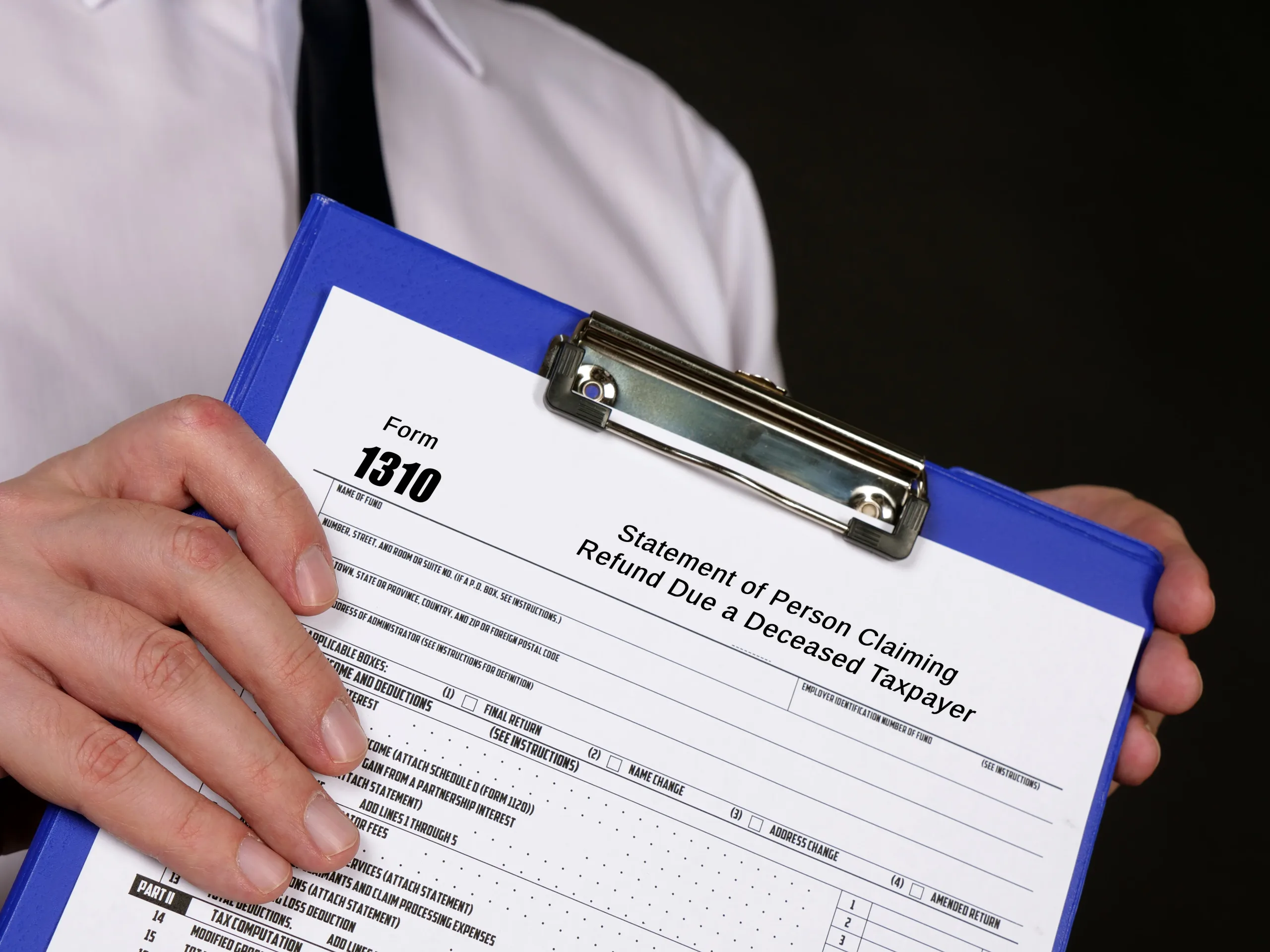
Filing Form 1310 is how you formally tell the IRS who has the legal authority to receive a refund that belonged to someone who has passed away. This guide covers the current revision Form 1310 (Rev. December 2025) and walks you through every step, from gathering documents to submitting the form correctly.
You may be dealing with this while also managing grief and estate logistics. The goal here is to break it into clear, manageable steps so nothing gets missed and nothing gets delayed.
Handling a deceased taxpayer’s return involves details that are easy to miss under normal circumstances, let alone during a difficult time. If you would like someone to take the more complicated parts off your plate, Simplicity Financial’s tax preparation services are available entirely online, serving families and estates across California and nationwide.
What is Form 1310 and Why Does it Exist?
IRS Form 1310 is officially titled the “Statement of Person Claiming Refund Due a Deceased Taxpayer.” It exists because the IRS cannot simply send a refund to someone who has died. Before releasing that money, the agency needs written confirmation that the person requesting it has the legal authority to do so.
Form 1310 is a purely administrative IRS document. It is not a probate form, and it is not filed with any court. It is filed with the IRS alongside the deceased taxpayer’s final return or, in some cases, with an amended return.
The form gives the IRS three pieces of information: who the deceased was, who is making the claim, and what legal basis that person has to make it. Without this documentation, the IRS has no way to verify that the refund is going to the right person.
This is a federal form. Each state has its own process for handling deceased taxpayers’ state income tax refunds, which may require separate documentation. This guide addresses only the federal process.
Who Must File Form 1310 and Who Can Skip It

Not everyone claiming a refund on behalf of a deceased taxpayer is required to file Form 1310. Whether you need it depends on your relationship to the deceased and what documentation you can attach to the return.
When Form 1310 is legally required
You must file Form 1310 in these situations:
- You are a surviving spouse filing a separate return (not a joint return) for the year of the deceased’s death.
- You are a court-appointed personal representative but you are not attaching a copy of your official court appointment certificate to the return.
- You are any other person, such as an adult child, sibling, or close friend, who is claiming the refund and has no court appointment.
The simple version: if you do not have court paperwork that clearly establishes your legal authority, and you are not a surviving spouse filing jointly, you need to file this form.
Who is exempt from filing Form 1310
Two groups do not need to file Form 1310:
- A surviving spouse filing a joint return with the deceased for the year of death. The joint return itself establishes the spouse’s identity and claim.
- A court-appointed personal representative who attaches a copy of their official court certificate (letters testamentary or letters of administration) directly to the return.
In both cases, the attached documentation or the return type itself serves the same function that Form 1310 would otherwise serve.
A common question is whether an executor needs to file Form 1310. The answer depends entirely on whether you are attaching your court appointment documents to the return. If you have those documents and include them, you do not need the form. If you cannot attach them, you do.
Table formatting: all cells, 1pt black border, applied to entire table.
| Claimant Type | Form 1310 Required? | Alternative Documentation |
| Surviving spouse filing joint return | No | Joint return serves as verification |
| Surviving spouse filing separate return | Yes | None accepted in place of Form 1310 |
| Court-appointed representative with court certificate attached | No | Copy of letters testamentary or letters of administration |
| Court-appointed representative without court documents | Yes | None accepted in place of Form 1310 |
| Any other claimant (adult child, sibling, friend) | Yes | None accepted in place of Form 1310 |
Documents and Information to Gather Before You Start

Before you fill out a single line of Form 1310, gather everything on this list. Starting without these items is the most common reason people make errors or have to restart midway through.
- The deceased taxpayer’s full legal name as it appeared on their tax returns
- The deceased’s Social Security Number (SSN)
- The date of death
- A completed copy of the final tax return you are attaching Form 1310 to
- Your full legal name, SSN, and current mailing address
- Proof of your relationship to the deceased if you are not the surviving spouse
- Court appointment documents if you are a personal representative (letters testamentary or letters of administration)
- Bank account and routing number if you want the refund issued via direct deposit
If the taxpayer passed away partway through the year, you will need to gather income records from every source up to the date of death. That can include wages, retirement distributions, investment income, and self-employment income reported on various forms. If the deceased received proceeds from a property sale, you may also need to address how that income is reported before completing the return. A CPA familiar with final return filings can help identify what applies to your situation.
One mistake that slows people down: not having the deceased’s SSN readily available when they sit down to complete the form. Locate it on a prior tax return, Social Security card, or government-issued document before you begin.
Step-by-Step Instructions for Completing Form 1310
During tax season, the team at Simplicity Financial regularly guides clients through final return filings for deceased family members. One of the most consistent patterns they see is that first-time filers are genuinely unsure which box to check in Part I of Form 1310, and that single point of confusion is enough to delay a refund by weeks or trigger an IRS notice.
Here is how to complete Form 1310 (Rev. December 2025) correctly, field by field.
Step 1: Enter the deceased taxpayer’s name
Write the name exactly as it appears on the tax return you are filing. Do not abbreviate or use a nickname. A mismatch between the name on Form 1310 and the name on the return is a common cause of processing delays.
Step 2: Enter the deceased taxpayer’s Social Security Number
This goes in the field directly below the name. Double-check this number against a prior return or official document. An incorrect SSN will cause the form to fail verification.
Step 3: Enter your name as the person claiming the refund
Use your full legal name. This must match the name associated with the SSN you provide in the next step.
Step 4: Enter your SSN and mailing address
The IRS uses this to identify you as the claimant and to send correspondence. Use the address where you want any mailed correspondence to go.
Step 5: Complete Part I by selecting the box that describes your relationship to the deceased
This is the most critical step. There are three options.
Box A is for a surviving spouse. Check this box only if you were legally married to the deceased at the time of their death and you are not filing a joint return. If you are filing jointly, you do not need this form at all.
Box B is for a court-appointed personal representative. Check this box if you have been formally appointed by a probate court and you are not attaching your court certificate to the return. If you are attaching the certificate, you do not need this form.
Box C is for everyone else. This includes adult children, siblings, other relatives, and any person who has not been court-appointed but is claiming the refund because they are responsible for the estate. If you check Box C, you must complete Part II.
A practical example: an adult daughter whose father passed away without a will and without a surviving spouse would check Box C. A widow filing a separate return for the year of her husband’s death would check Box A.
Step 6: Complete Part II if you checked Box B or C
Part II asks two yes/no questions. The IRS uses these to determine whether a formal legal process is in place and whether there are prior claims on this refund.
Question 1 asks whether a probate court proceeding has been or will be filed for the deceased’s estate. Answer honestly. If you are unsure whether probate is required in your state, consult a local estate attorney before answering. Providing false information on a federal form carries legal consequences.
Question 2 asks whether you have filed a refund claim for this taxpayer before. Answer yes if you have previously submitted Form 1310 or any other refund claim for this person. Answer no if this is the first time.
Step 7: Sign the perjury statement
The certification at the bottom of the form states that the information you provided is true and correct under penalty of perjury. Sign and date the form before submitting. An unsigned Form 1310 will be rejected automatically.
Step 8: Attach Form 1310 to the completed return
Form 1310 does not get filed on its own. It is always submitted as an attachment to the tax return. Place it as the top document in the package when mailing.
Common Filing Errors and How to Avoid Them

These are the mistakes that create the most delays:
- Checking the wrong box in Part I. Re-read the description for each box before selecting.
- Name mismatch between Form 1310 and the tax return. Use the name exactly as it appears on prior returns.
- Missing SSN for the deceased. Locate it before you start, not during.
- Forgetting to sign and date the form. An unsigned form is automatically invalid.
- Filing Form 1310 separately from the return. It must always be attached.
If you review the completed form and are still unsure whether it is filled out correctly, having a CPA check it before submission costs far less than the delay a rejected form creates.
How to Submit Form 1310: Mailing vs. E-Filing Options
Form 1310 generally cannot be e-filed as a standalone document, but that does not mean you are automatically limited to paper filing.
If you are using tax software to prepare the final return, many programs allow you to include Form 1310 electronically as part of the e-filed package. The availability of this option varies by software. Check your platform’s help documentation to confirm whether electronic submission of Form 1310 is supported. If it is not, you will need to file the entire return on paper.
If you are filing on paper, print and sign both the tax return and Form 1310, then mail them together to the IRS address for your state. Mailing addresses for individual returns vary by state and can be found on the IRS “Where to File” page. Do not assume the address is the same as the one used for prior returns.
If the return you are attaching Form 1310 to is an amended return, see our overview of tax preparation services to understand how a CPA can help manage that process. Amended returns require paper filing regardless of software, which adds processing time, so filing everything correctly the first time matters.
For paper submissions, expect processing to take 6 to 8 weeks at minimum. According to the IRS Taxpayer Advocate Service, the IRS has worked through a significant portion of its backlog of deceased taxpayer refund returns in recent years, though delays remain common during peak filing season. Filing correctly the first time is the clearest way to avoid that backlog.
What Happens After You File: Tracking the Refund and Handling IRS Notices
After you submit Form 1310, the IRS reviews the form and verifies that the person claiming the refund has the authority to do so. Only after that review is complete will it release the refund.
Paper returns with Form 1310 attached typically take 6 to 8 weeks to process, though it can take longer during busy periods. The IRS “Where’s My Refund” tool has limited usefulness for paper-filed returns and may not show an update until the return has been manually entered into the system.
If the IRS needs additional documentation, it will mail a notice to the address you provided on the form. Respond promptly and include exactly what the notice requests. Delays in responding extend the processing timeline significantly.
One situation that catches people off guard: if the refund check is issued in the name of the deceased taxpayer rather than the claimant, you cannot simply deposit it. The correct step is to return the check to the IRS with a written explanation and a request to reissue it in the appropriate name. Getting Part I of Form 1310 filled out correctly from the start prevents this.
If the deceased owed back taxes, student loan debt, or other federal obligations, the IRS may apply some or all of the refund against those debts before issuing any payment. This is not something Form 1310 can override, and you will receive a notice if an offset is applied.
When to Hire a Tax Professional for a Deceased Taxpayer’s Return
The answer depends on how complicated the deceased’s financial situation was.
Handling it yourself is reasonable when the return is straightforward, income came from a single source, the surviving spouse is filing jointly, and the estate has no complications.
Professional help is worth considering in these situations:
- The deceased had income from multiple sources, including self-employment, rental property, or investments
- There are prior-year unfiled returns that need to be addressed
- A trust is involved or the estate is subject to estate tax
- There is no clear legal authority to claim the refund and the question of who should file is genuinely uncertain
- State tax obligations in multiple states are involved
- The deceased owed back taxes and the refund may be subject to offset
Final returns for deceased taxpayers involve details and judgment calls that go beyond standard annual return preparation. Simplicity Financial’s tax preparation services support this type of complex filing, working entirely online with clients across California and nationwide. The goal is that you leave the process with less on your plate, not more.
Frequently Asked Questions About Form 1310
Can a sibling or adult child file Form 1310 if there is no surviving spouse?
Yes. Any person claiming a refund on behalf of a deceased taxpayer who is not a court-appointed representative with attached court documents must file Form 1310. A sibling or adult child would check Box C in Part I and complete Part II. There is no requirement that the claimant be a spouse or legal heir, but the person signing the form is certifying under penalty of perjury that the information is accurate.
What if the deceased had no will and no court-appointed representative?
When no one has been formally appointed by a probate court, any person responsible for handling the estate’s affairs can file Form 1310 by checking Box C. The IRS does not require probate appointment to file the form. If the estate is significant, consulting an estate attorney before filing is a reasonable step to confirm the right person is making the claim.
Does Form 1310 need to be notarized?
No. The perjury certification at the bottom of the form, which you sign and date, is sufficient. No third-party verification of your signature is required by the IRS.
What if the deceased owed back taxes? Will the refund still be paid?
Not necessarily. The IRS can apply refunds to outstanding federal tax debt, child support, federal student loans, or other qualifying debts through a process called an offset. You will receive a notice if an offset is applied. Filing Form 1310 correctly ensures the claim is processed, but it does not prevent a legitimate offset.
Can I use Form 1310 to claim refunds for multiple prior tax years?
Yes. If the deceased is owed refunds from more than one tax year, you will need to file a separate Form 1310 for each year’s return. Each return is processed individually and needs its own accompanying form.
How long do I have to claim a refund for a deceased taxpayer?
The IRS applies the standard three-year statute of limitations for refund claims. The claim must be filed within three years of the original due date of the return (including extensions) or within two years of the date the tax was paid, whichever is later. Waiting too long means forfeiting the refund entirely.
Filing Form 1310 Correctly is What Protects the Refund
Form 1310 is a specific, manageable process once you understand who needs to file it, what to include, and how to submit it correctly. The details that trip people up (wrong box in Part I, name mismatches, missing signatures) are all avoidable with careful preparation.
If the situation involves more complexity than this guide covers, whether that is multiple income sources, prior unfiled years, or genuine uncertainty about who should file, Simplicity Financial can take it from there. Working entirely online, the team supports families and estates across California and nationwide through exactly this kind of filing. Book a free consultation and we will help make sure the refund that was earned does not get lost in the process.
Disclaimer: This article is for general informational purposes only and should not be taken as tax, accounting, legal, or financial advice. Rules can change, and the right approach depends on your specific situation. For guidance related to your personal, business, nonprofit, or ministry finances, speak with a qualified CPA or tax professional.