

So, how much do tax resolution services cost? Prices vary widely, from a few hundred dollars for a straightforward penalty abatement request to several thousand dollars for a complex Offer in Compromise or a case involving multiple years of unfiled returns. The cost of tax resolution services depends on the complexity of the situation, the amount of back tax debt involved, and whether a CPA firm, tax attorney, or national resolution company handles the work.
This guide breaks down what drives that price, the different ways providers charge for tax resolution work, and how to decide whether hiring help is worth it for your situation.
How Much Do Tax Resolution Services Actually Cost?
No single standard rate exists for tax resolution work. Published industry estimates generally range from $1,000 to $10,000 or more, depending on the case.
Simpler Cases, Lower Cost
A first-time penalty abatement or a basic installment agreement setup usually falls on the lower end, since there’s less back-and-forth with the IRS and fewer documents to prepare.
Complex Cases, Higher Cost
An Offer in Compromise, a Trust Fund Recovery Penalty defense, or a case spanning several years of unfiled returns takes more time to prepare and negotiate, which puts it toward the higher end of the range.
What Actually Drives the Cost of Tax Resolution Services

A few factors shape the price no matter who handles the case:
- Type of relief needed
- Amount owed and number of tax years involved
- Whether returns are filed or still need to be prepared
- Individual tax debt vs. business or payroll tax debt
- Urgency, such as an active levy or wage garnishment
Common Tax Resolution Pricing Models
Providers in this space typically price their services one of three ways. Understanding which model a provider uses helps explain why one quote might look different from another, even for a similar case.
Flat Fee
A set price for a defined scope of work. Common for simpler, well-defined cases like a single penalty abatement request. The tradeoff is that flat fees are often set before all the facts of a case are known.
Hourly Billing
The fee scales with the actual time and complexity involved. This is common among CPA firms and tax attorneys, where cases vary too much to set a one-size-fits-all price. This model tends to reflect the real work involved more closely, since the fee grows or shrinks with the case itself.
Retainer Plus Hourly
An upfront deposit followed by hourly billing as the case progresses. Often used for larger, ongoing matters, such as an Offer in Compromise. The retainer covers the early review and filing work, with additional hours billed as the case develops.
What the Price Usually Covers
Regardless of the pricing model, most tax resolution engagements include an initial case review, preparation of any required forms, and direct communication with the IRS on the client’s behalf. Some cases also require preparing or amending prior returns before you can request any relief option, which increases the scope and cost.
DIY vs. Hiring a CPA for Tax Resolution
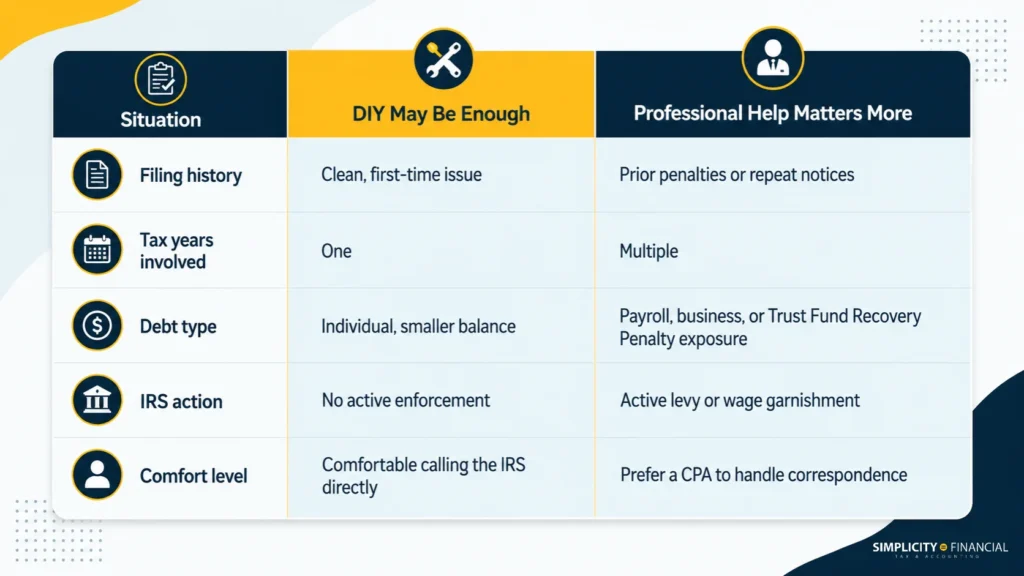
Not every tax problem requires paid help. The decision usually comes down to how much is at stake and how complicated the paperwork has become.
When DIY May Be Enough
A first-time penalty on an otherwise clean filing history can sometimes be resolved with a direct call to the IRS or a First Time Abatement request, without paying for outside help. Simple installment agreements on smaller balances can also often be set up directly.
When Professional Help Matters More
Payroll tax problems, Trust Fund Recovery Penalty exposure, and multiple years of unfiled returns involve enough at stake that a professional review is usually worth it. These cases often carry personal liability, tight deadlines, or the risk of a levy, and mistakes can be expensive to unwind later.
The right approach depends on how much is owed, how many notices you have received, and how comfortable you are handling IRS correspondence directly. When in doubt, a short conversation with a CPA can clarify which category a situation falls into before any money changes hands.
Why Choose Simplicity Financial?
Simplicity Financial doesn’t offer packaged, one-size-fits-all pricing. Every engagement is scoped after Shaun Glenn, CPA, MSA, MST, reviews the actual notices, filing history, and financial picture behind it. That review happens before we discuss any price, not after. This deliberate approach is built around the same CPA-led process used for bookkeeping, accounting, and payroll clients across Simplicity Financial’s church, nonprofit, and closely held business niche.
A CPA-Led Review, Not a Call Center Script
Shaun brings 15+ years focused exclusively on nonprofit and church finance, along with CPA, MSA, and MST credentials, to that review. That combination matters here, since tax resolution work is a licensed-professional service, not a script read off a call center floor. A CPA reviewing a case can spot issues a non-credentialed representative might miss, and can speak directly to the IRS with the authority that license carries.
What Simplicity Financial’s Tax Resolution Services Cover
Simplicity Financial’s tax resolution services cover the full range of IRS relief options:
- Installment agreements
- Offers in Compromise
- Currently Not Collectible status
- Penalty abatement
- Innocent spouse relief
- Payroll tax issues, including unpaid 941 taxes and Trust Fund Recovery Penalty exposure
Each of these starts with the same step: a CPA-led review of the actual notices and financial picture, not a generic intake form.
Is Paying for Tax Resolution Help Worth It?

The cost of tax resolution services depends on a few factors: the type of relief needed, how many tax years are involved, whether returns still need to be filed, and whether payroll tax debt is part of the picture.
The value of paying for help isn’t a guaranteed dollar amount saved. It’s accuracy: pursuing the relief option that actually fits the situation, and having a licensed CPA handle the paperwork and IRS communication directly. This is where Simplicity Financial’s case-by-case approach fits in. Shaun Glenn, CPA, MSA, MST, reviews the actual notices, filing history, and financial picture first, then outlines what the situation may qualify for.
If back taxes, unfiled returns, or an IRS notice are part of the picture, schedule a phone call or Zoom meeting to review the situation and outline the options.
FAQs About Tax Resolution Service Costs
How much does tax relief cost?
Published ranges commonly run from a few hundred dollars for simple requests to $10,000 or more for complex, multi-year business cases.
Is a tax resolution service worth the cost?
For simple, first-time issues, sometimes not. For payroll tax problems, multi-year debt, or active levies, professional review often prevents costly missteps.
What’s the difference between flat-fee and hourly tax resolution pricing?
Flat fee means one set price for a defined scope. Hourly billing scales with the actual time and complexity of the case.
Can I resolve tax debt myself without paying for help?
In some simple cases, yes. Once payroll taxes, multiple years, or an active levy are involved, a CPA review is generally worth the conversation.
Why doesn’t Simplicity Financial list its tax resolution fees online?
Because pricing depends entirely on the details of each case. A CPA review comes first, and the scope of that review determines the cost.
Disclaimer: This article is for general informational purposes and does not constitute tax, legal, or financial advice. Every tax situation is different. Contact Simplicity Financial for a review of your specific circumstances.