

Form 5471 shows up when the IRS wants visibility into a foreign corporation tied to a U.S. person. The practical problem is never the paper itself. It’s the story the paper must tell: who owns what, what changed, and what moved between related parties.
The official IRS Form 5471 instructions explain the filing mechanics in full. The challenge is turning that into a clean workflow you can repeat every year without turning your February into forensic accounting.
Simplicity Financial works with U.S. clients remotely, including owners and executives who need their Form 5471 filing requirements handled accurately and defensibly. The difference between a smooth year and a stressful one usually comes down to preparation: clean books, a complete document pack, and the right schedules for your filer category.
What Is Form 5471, Really
What is Form 5471? In practice, it’s the IRS’s structured way to ask for ownership and financial reporting for certain U.S. persons connected to a foreign corporation. People call it the 5471 form, the 5471 tax form, or IRS Form 5471 depending on what they searched at 2:00 a.m., but the job stays the same: disclose the right information for your category.
A quick example makes this concrete. A U.S. founder owns 70% of a corporation incorporated abroad that sells consulting services. There may be intercompany payments. There may be loans. There may be retained earnings. A “simple return” suddenly has a serious international appendix, and Form 5471 instructions determine what that appendix must include.
Thinking of Form 5471 Category Filers Like a Business Decision
Most of the complexity in Form 5471 categories comes from one idea: different relationships trigger different reporting. The IRS doesn’t treat “minor investor” and “controller” the same way.
Think of Form 5471 category filers as buckets based on how you relate to the foreign corporation. Some categories are about becoming an officer or director in the context of certain ownership levels. Some are about crossing ownership thresholds through acquisition or disposal. Some are about control. Some apply to U.S. shareholders of controlled foreign corporations.
That’s the reason “fill out the form” isn’t a helpful instruction. The real instruction is: identify your filer category, then follow the schedule list required for that category. That’s the heart of Form 5471 category filers explained.
The Schedule Map That Stops the Alphabet Soup
The most common mistake on a 5471 tax form is completing the wrong schedules, or overbuilding the package with irrelevant schedules while still missing the required ones. This table gives you a plain-English “what this schedule is doing” reference.
| Schedule | What it captures in plain English | When it typically matters |
| Form 5471 Schedule O | Ownership details and changes during the year | New filers, ownership changes, reorganizations |
| Form 5471 Schedule J | Earnings and profits tracking | When E&P reporting is required |
| Form 5471 Schedule M | Related-party transactions | Fees, services, royalties, loans, reimbursements |
| Form 5471 Schedule E | Foreign taxes paid or accrued | When foreign tax detail is required |
| Form 5471 Schedule H | Current E&P computations | E&P reporting cases |
| Form 5471 Schedule P | Previously taxed E&P (PTEP) accounts | CFC/PTEP tracking |
| Form 5471 Schedule Q | Additional PTEP detail | When PTEP reporting expands |
You’ll see searches for Form 5471 schedule o instructions because Schedule O is often the schedule that “starts the story” for a filer, especially when ownership shifted.
Form 5471 Filing Requirements Start With Records, Not Tax Theory

A clean Form 5471 filing usually starts with the same record pack. When this is complete, the schedules get easier. When this is incomplete, everything gets expensive.
The core record pack:
- Ownership records (cap table, subscription agreements, transfer docs)
- The foreign corporation’s financial statements
- Trial balance or general ledger (if available)
- Related-party transaction detail (fees, loans, reimbursements, royalties, services)
- Foreign tax statements (if foreign taxes were paid or accrued)
- Prior-year workpapers and schedules (especially where continuity matters)
If your numbers live in five spreadsheets and two inboxes, you’re not alone. That’s also where a structured system pays for itself. This is the kind of scenario where outsourced bookkeeping services can keep related-party flows and corporate activity organized so Schedule M and E&P schedules don’t turn into guesswork.
Form 5471 Schedule O and the “Threshold Moment”
Form 5471 Schedule O is where a lot of filers discover the real issue: their filing obligation didn’t appear out of nowhere. Something changed.
Example: A U.S. person held 9% of a foreign corporation. Mid-year, they purchase another 12%. The ownership change can trigger new reporting outcomes, and Schedule O is often where that change is disclosed.
This is why “nothing happened this year” is rarely a safe assumption. Ownership changes can be quiet. Reporting rules are not.
Form 5471 Schedule M: Related-Party Transactions That Require Detail
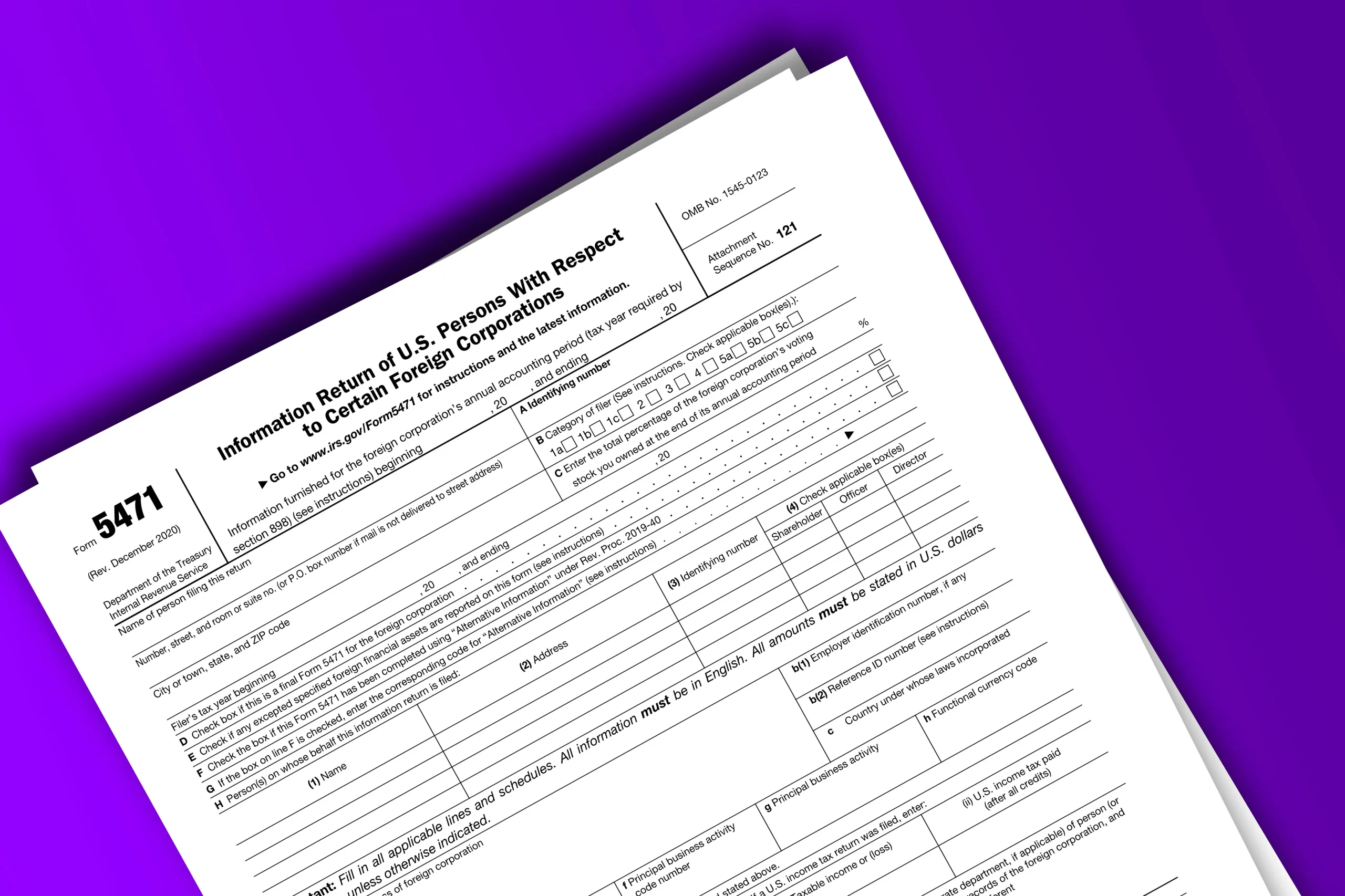
Form 5471 Schedule M reports transactions between the foreign corporation and related parties. It’s not limited to “unusual” activity. It’s the schedule that captures routine cross-entity money movement in a way the IRS can actually follow.
What belongs here most often:
- Service and management fees (advisory, admin, technical support, shared staff)
- Royalties and licensing fees (IP, software, brand licensing)
- Interest and loans (shareholder loans, intercompany financing, repayment terms)
- Rents and leases (equipment, office space, vehicles)
- Purchases and sales of goods (inventory, resale items, intercompany cost sharing)
- Cost allocations and reimbursements (shared expenses, chargebacks, pass-through costs)
What the IRS will expect you to be able to support:
- Who paid whom (which entity, which related party)
- What the payment was for (the business reason, not just “consulting”)
- When it happened (timing across the year)
- How the amount was determined (invoice, agreement, allocation method)
- How it was recorded on both sides (matching books and financial statements)
Example: A foreign corporation pays a U.S.-owned LLC a monthly management fee. Schedule M isn’t just “yes, fees happened.”
You need a consistent story:
- a written agreement or scope (what services were provided)
- the invoicing or calculation method (flat fee vs hourly vs percentage allocation)
- proof the payments match the general ledger and bank activity
- consistent classification in the books (fees vs reimbursement vs loan repayment)
The most common failure isn’t that the payments exist. It’s that the documentation is vague, the categories are inconsistent, or the books don’t tie out between entities. If you want Schedule M to be straightforward, track related-party transactions as their own category all year, and keep the supporting contracts, invoices, and allocation notes in one place.
Form 5471 Schedule J and Schedule H: Earnings and Profits Without the Meltdown
Form 5471 schedule j and Form 5471 schedule h are where filings can feel technical because they involve earnings and profits (E&P). The schedules aren’t scary. Incomplete source data is.
A realistic example: A corporation shows book profit, but E&P differs due to adjustments. If your filer category requires E&P reporting, these schedules translate activity into the format the IRS expects, consistently and year-over-year.
This is a common inflection point where people stop DIYing. Not because they lack intelligence. Because the risk of a sloppy E&P story is higher than the cost of professional support. For teams that want the filing done correctly without building an in-house workflow, tax preparation outsourcing is often the cleanest path.
Form 5471 Schedule E: Foreign Tax Details That Need Receipts
Form 5471 schedule e tracks foreign income taxes paid or accrued, where required. The mistake here is treating tax statements like “nice to have.” If you can’t support what was paid, to whom, and for what period, you end up with a weak filing narrative.
If you want a clearer way to understand how forms connect and how the IRS reads a return as one story, how to read tax returns helps build the skill that prevents mismatched numbers across schedules.
Form 5471 Schedule P and Schedule Q: Continuity Matters More Than Speed

Form 5471 schedule p and Form 5471 schedule q often show up in situations involving previously taxed earnings and profits. These schedules punish improvisation because they rely on continuity.
Example: One year of incorrect PTEP tracking doesn’t stay in that year. It becomes a rolling problem that makes the next year worse, and the year after that even worse.
This is the “slow down to go fast” part of Form 5471 instructions. A consistent record today prevents amendments later.
Form 5471 Penalties: Why “Close Enough” Can Get Expensive
People search Form 5471 penalties for a reason. The filing is an information return with serious consequences if it’s not filed correctly. You’ll also see form 5471 penalty used in singular form, but the intent is the same: avoid an avoidable mess.
The best defense is boring:
- confirm your filer category early
- gather a complete record pack
- complete required schedules accurately
- keep workpapers that support the numbers
If anxiety is creeping in, it helps to separate the idea of an audit from the reality of compliance work. This explanation of audit vs tax accounting can reduce the mental noise so the focus stays on execution.
Form 5471 News: What Actually Changes Year to Year
Most “form 5471 news” online reads like a siren. The practical truth is calmer: the best protection is a repeatable process and solid records.
When you treat Form 5471 filing requirements like an annual workflow, you get:
- faster prep time
- fewer surprises
- cleaner continuity for E&P and PTEP schedules
- less “where did that number come from?” in future years
That’s not flashy. It’s how sophisticated businesses stay compliant without burning leadership time.
Remote Support That Fits Cross-Border Reality
International reporting often breaks when companies try to bolt it onto a domestic bookkeeping system. Cross-border ownership needs clean classification, consistent recordkeeping, and an annual cadence that doesn’t rely on memory.
Simplicity Financial supports that operational side through remote accounting services, especially when business owners need ongoing structure instead of a once-a-year scramble.
International filings also tend to travel in packs. Depending on your facts, you may also be dealing with other foreign reporting obligations like Form 3520 or Form 3520-A. The filing strategy is always fact-dependent, but the workflow benefit is the same: one organized system beats three frantic ones.
For more tax strategy and compliance content, explore the Simplicity Financial blog.
Form 5471: Next Steps With Simplicity Financial
A strong Form 5471 filing is a clean story backed by documents: correct category, correct schedules, reconciled numbers, and support for every meaningful transaction.
If you want help confirming your category, building the document pack, and filing confidently with a remote team, start with Simplicity Financial here: request a consultation.
Frequently Asked Questions About Form 5471
What is Form 5471 and when does it apply
What is Form 5471? It’s an information return used by certain U.S. persons to report ownership and activity related to a foreign corporation, based on the filer categories and schedule requirements in the IRS instructions.
Which schedules matter most on the 5471 form
The required schedules depend on your filer category, but common schedules include Form 5471 Schedule O, Form 5471 Schedule M, and E&P schedules like Form 5471 Schedule J and Form 5471 Schedule H.
Do I always need Form 5471 Schedule O instructions
If ownership changed or your filer status is tied to acquisitions, dispositions, or organizational details, Schedule O is often central. It’s a frequent starting point in the schedule package.
Why do people worry about Form 5471 penalties
Form 5471 penalties can be significant because the form is an information return. That’s why accurate category identification, complete schedules, and supportable records matter.
Where can someone get help with IRS Form 5471
For remote support across the U.S., Simplicity Financial can help owners build a clear workflow for international reporting and file accurately.
Disclaimer
This article is for general informational purposes only and does not constitute legal, tax, or accounting advice. Readers should consult a qualified professional for guidance tailored to their situation and verify details with official IRS guidance before making decisions.