What is Form 8880 and the Saver’s Credit?
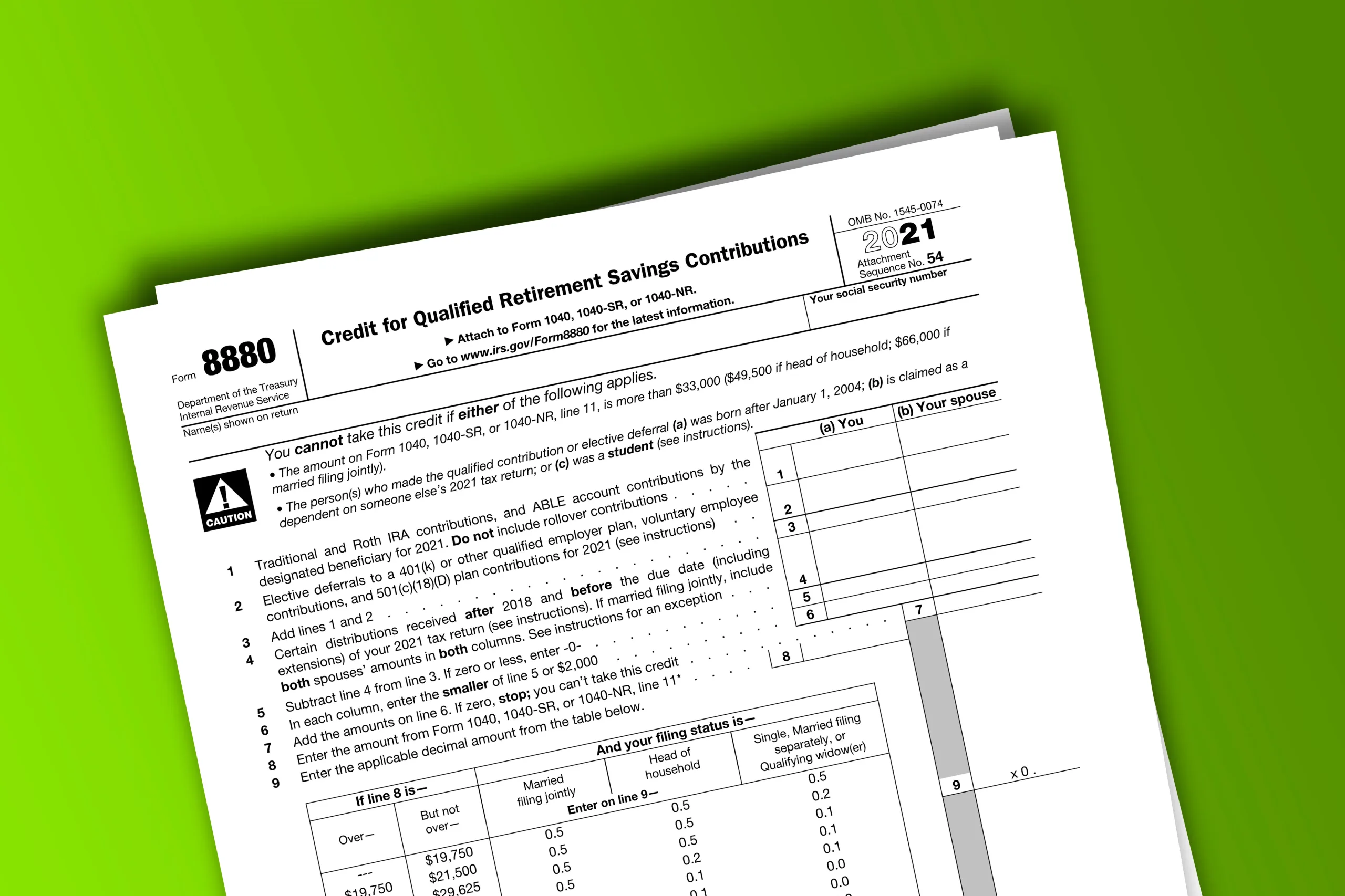
Form 8880 is the IRS form used to calculate and claim the Credit for Qualified Retirement Savings Contributions, more commonly called the Saver’s Credit. If you contribute to a retirement account and earn below certain income thresholds, Form 8880 determines how much of a tax credit you can claim on your federal return.
Before going further, here is a quick distinction worth knowing. A tax deduction reduces the amount of income that gets taxed. A tax credit reduces your actual tax bill, dollar for dollar. Think of it this way: if your tax liability is a grocery bill, a deduction is a coupon applied to certain items before the total is calculated. A credit is cash taken directly off the register total. The Saver’s Credit is the latter, which makes it more powerful for eligible filers.
The credit exists to reward low-to-moderate income earners for putting money aside in qualifying retirement accounts like a 401(k) or IRA. The maximum credit is $1,000 for single filers and $2,000 for married couples filing jointly. One important caveat: the Saver’s Credit is nonrefundable. It can reduce your tax bill to zero, but it will not generate a refund beyond that.
According to the Transamerica Institute’s 26th Annual Retirement Survey, only 48% of U.S. workers are aware of the Saver’s Credit, meaning more than half of eligible workers may be missing out on a valuable tax break. Taxpayers must file IRS Form 8880 with their federal return to claim this benefit.
If you have been contributing to a retirement plan and earning within the qualifying income range, there is a real chance this credit applies to you.
Working with a CPA takes the guesswork out of forms like this one. If you want someone to review your return and make sure every credit is accounted for, Simplicity Financial’s tax preparation services are available entirely online — serving clients across California and nationwide.
Who is Eligible for the Saver’s Credit?

Eligibility for the Saver’s Credit comes down to three conditions, plus an income test. You need to pass all of them before Form 8880 is relevant to your return.
1. You must be at least 18 years old
This applies to the tax year in question, not your current age.
2. You cannot be claimed as a dependent
You cannot be claimed as a dependent on someone else’s tax return. This one catches more people than you might expect. A 22-year-old recent graduate whose parents still claim them is not eligible, even if they are working and contributing to a Roth IRA.
3. You cannot have been a full-time student for five or more months
Part-time enrollment does not disqualify you. Only full-time enrollment meeting the five-month threshold counts. A single semester of full-time classes spanning August through December, for example, would cover five months and remove eligibility for that year.
Quick eligibility check
- Are you 18 or older? No → you do not qualify. Yes → continue.
- Can someone else claim you as a dependent? Yes → you do not qualify. No → continue.
- Were you a full-time student for five or more months? Yes → you do not qualify. No → continue.
- Is your AGI within the income limits? No → you do not qualify. Yes → proceed to calculate your credit.
If you are a 25-year-old working part-time, contributing to a Roth IRA, and not enrolled full-time in school, you likely pass all three gates. Run the income test next.
Income thresholds for 2025
The income limits are based on your adjusted gross income (AGI), not your gross pay. For 2025, the upper AGI limits are:
| Filing Status | AGI Limit |
| Single / Married Filing Separately | $39,500 |
| Head of Household | $59,250 |
| Married Filing Jointly | $79,000 |
One common scenario worth checking: a single filer earning $40,000 in AGI for 2025 falls just over the $39,500 threshold and receives no credit. If that same person contributed to a traditional IRA, the resulting deduction might bring their AGI below the limit and restore eligibility. That is worth reviewing with a CPA before filing.
How to Calculate the Saver’s Credit

The Saver’s Credit is not a flat amount. It is a percentage of your eligible retirement contributions, and that percentage depends on your income. According to the IRS, the Saver’s Credit can be worth 10%, 20%, or 50% of your retirement contributions, depending on your filing status and AGI.
Which percentage applies to your income?
Your applicable rate is determined by where your AGI falls within the income tiers. The figures below reflect 2024 IRS thresholds as published in IRS Revenue Procedure 2023-34. Verify 2025 figures against current IRS guidance before filing.
| Filing Status | 50% Rate | 20% Rate | 10% Rate |
| Single / Married Filing Separately | Up to $22,000 | $22,001–$24,000 | $24,001–$36,500 |
| Head of Household | Up to $33,000 | $33,001–$36,000 | $36,001–$54,750 |
| Married Filing Jointly | Up to $44,000 | $44,001–$48,000 | $48,001–$73,000 |
Even the lowest tier matters. A single filer contributing $2,000 to a retirement account at the 10% rate still gets $200 taken directly off their tax bill.
Why your eligible contribution amount might be lower than expected
The IRS applies a testing period when calculating your eligible contributions. That period covers the current tax year, the prior tax year, and the first 60 days of the year following the tax year you are filing for. If you took distributions from any retirement account during that window, those distributions reduce the amount of contributions that qualify for the credit.
Here is a straightforward example. A single filer earns $28,000 in AGI, contributed $2,000 to a Roth IRA, and took no distributions. At the 50% credit rate, their credit is $1,000 — the maximum for a single filer.
Now change one detail. Same filer, but they withdrew $500 from a retirement account earlier in the year. Their eligible contribution drops to $2,000 minus $500, which equals $1,500. At 50%, the credit becomes $750.
One clarification worth making: rollovers from one retirement account to another do not count as distributions that reduce your credit. They are also not eligible contributions. Rollovers are neutral for Form 8880 purposes.
How to Complete IRS Form 8880: Line-by-Line Walkthrough
IRS Form 8880 has two parts. Part I calculates your eligible contributions after accounting for any distributions. Part II applies the credit rate to determine your final credit amount.
The walkthrough below uses a sample scenario throughout. Assume a married couple filing jointly. One spouse contributed $2,000 to a traditional IRA, and the other contributed $1,500 to a 401(k). Neither took any distributions.
1. Lines 1a and 1b — traditional IRA contributions
The primary taxpayer enters their amount on Line 1a, and the spouse enters theirs on Line 1b. In this example, $2,000 goes on Line 1a and $0 on Line 1b, because the spouse’s contribution was to a 401(k), not an IRA. Note: confirm this column structure against the current IRS Form 8880 PDF, as form layouts can change.
2. Line 2 — employer-sponsored plan contributions
This line is for contributions to employer-sponsored plans, including 401(k), 403(b), SIMPLE, and SEP plans. The spouse’s $1,500 contribution goes here.
3. Line 3 — total eligible contributions
Line 3 adds Lines 1 and 2. In this example, $2,000 plus $1,500 equals $3,500.
4. Line 4 — distributions during the testing period
Line 4 captures distributions received during the testing period. In this scenario, the couple took none, so Line 4 is $0.
5. Line 5 — net eligible contributions
Line 5 subtracts Line 4 from Line 3. Here, $3,500 minus $0 equals $3,500.
6. Line 6 — contribution cap
Line 6 caps the eligible amount at $2,000 per person, or $4,000 for joint filers. Since $3,500 is under $4,000, Line 6 stays at $3,500. Rollovers are not entered on any of these lines.
Part II: Turning your contribution into a tax credit
Part II uses the credit rate table to apply the correct percentage based on your AGI and filing status. Using the couple above, assume their joint AGI is $52,000, which falls within the 20% tier for married filing jointly. Twenty percent of $3,500 equals $700. That $700 is their tentative credit.
The final credit amount flows to Schedule 3, Line 4 of Form 1040. Because the Saver’s Credit is nonrefundable, it can reduce the couple’s tax liability to zero but cannot produce a refund beyond their actual tax owed.
One of the more common entry errors on Form 8880 is misassigning contributions between filers. If you meet all the conditions for the credit but the form is not generating, check that each contribution is assigned to the correct filer before looking elsewhere for the problem. Like Form 3922, which handles employee stock purchase plan reporting, Form 8880 is a supporting calculation — it does not stand alone but feeds a specific line on your 1040.
Common Mistakes to Avoid When Filing Form 8880

Most errors on Form 8880 are not intentional. They come from not knowing the rules, and the Saver’s Credit has several that are easy to overlook.
At Simplicity Financial, we regularly work with clients — from ministers and part-time workers to individuals making their first retirement contributions — who had no idea the Saver’s Credit existed, let alone that they had been leaving it unclaimed. Clean, well-organized records make it much easier to catch credits like this one before filing. The awareness gap is real, and having a CPA review your return before you submit it makes a direct difference in what you owe.
1. Counting rollovers as eligible contributions
Rollovers are not contributions. If you moved funds from an old 401(k) to an IRA, that does not count toward the credit and should not appear on Lines 1 or 2. Including a rollover inflates your eligible amount and leads to an incorrect credit.
2. Missing distributions in the testing period
A withdrawal taken in January or February of the following year can reduce your eligible contributions for the prior tax year. Many filers do not realize the look-back window extends into the new calendar year. If you took a distribution in early 2026 and are filing your 2025 return, that distribution may still affect your calculation.
3. Claiming the credit while enrolled full-time
Even one academic semester of full-time enrollment spanning five months is disqualifying. If you were a full-time student for five or more months of the tax year, the credit does not apply, regardless of your income or contributions.
4. Assuming no tax liability means no benefit
Some eligible filers skip the credit because they expect to owe nothing. If there is any tax liability before credits are applied, the Saver’s Credit reduces it. Always calculate before assuming the credit is irrelevant.
5. Expats using the Foreign Earned Income Exclusion (Form 2555)
If you exclude foreign income under Form 2555, that excluded amount must be added back to determine your modified AGI for Form 8880 purposes. A taxpayer who excludes $30,000 of foreign income may appear to have a low AGI, but after adding that income back, they could exceed the income thresholds entirely. This is a detail that often surfaces for self-employed individuals working remotely from abroad — worth flagging if that describes your situation.
One final note on credit sequencing: if other nonrefundable credits have already reduced your tax liability to zero, the Saver’s Credit has no remaining balance to reduce. The order in which credits are applied on your return affects whether Form 8880 produces any benefit at all.
How Form 8880 Fits Into Your Broader Retirement Strategy
Form 8880 is one piece of a larger retirement tax picture. Understanding how it compares to other incentives helps you get the most out of every dollar you contribute.
For lower-to-moderate income earners within the qualifying thresholds, the Saver’s Credit is typically the strongest immediate option. It is a direct reduction of your tax bill for contributions you are already making.
For higher earners who do not qualify for the Saver’s Credit, the more relevant benefit is the deduction from contributing to a traditional IRA or 401(k). That deduction reduces taxable income, which is valuable in higher tax brackets, but it does not carry the same immediacy as a credit.
One often-missed point: a traditional IRA deduction lowers your AGI, which can push you into a higher Saver’s Credit rate tier. The two incentives can work together on the same return. For a closer look at how income reporting affects your overall liability, see our post on how to report income on tax returns.
For filers age 50 and older, catch-up contributions allow you to put more into a retirement account each year. Those additional contributions can increase the base amount the credit percentage is applied to, provided you are still within the income limits.
Looking forward, the SECURE 2.0 Act is phasing in a Saver’s Match beginning in 2027. The nonrefundable credit will eventually be replaced by a government-funded matching contribution deposited directly into your retirement account. Even taxpayers with zero tax liability will benefit — addressing one of the current credit’s core limitations. These details are based on IRS guidance on SECURE 2.0 as of the time of writing; confirm current implementation timelines before making planning decisions.
A few states have also begun offering matching saver’s programs that supplement the federal benefit at the state level. If your state participates, you may be able to capture additional value on top of what Form 8880 provides.
For anyone managing a more complex financial picture — including self-employed individuals, small business owners, and nonprofit leaders — having a CPA review your return helps you see how these pieces interact. Our bookkeeping and accounting services keep your records organized throughout the year, so nothing gets missed when it matters most.
When and How to File Form 8880
Form 8880 is filed as an attachment to your federal Form 1040 and is due by the standard tax filing deadline of April 15. If you file for an extension, the deadline shifts to October 15. Filing an extension does not affect your eligibility for the credit itself.
One distinction worth noting: the distribution testing period extends to the first 60 days of the following calendar year regardless of whether you file an extension. An extension changes your filing deadline, not the window for which distributions are counted against your eligible contributions. Those are governed by separate rules.
The credit applies to the tax year in which qualifying contributions were made, not the year the form is submitted. If you contributed to a Roth IRA in 2025, that contribution is claimed on your 2025 return filed in 2026.
Most tax software will prompt you to complete Form 8880 if it detects qualifying retirement contributions during the interview process. If the form does not appear automatically, check that all eligibility conditions are entered correctly. The age, dependency status, and student status fields trigger the form to generate. If the form still does not generate after verifying all fields, a CPA can review the return and identify where the entry may have gone wrong.
Frequently Asked Questions About Form 8880
Can I claim the Saver’s Credit if I work remotely from another state?
Yes. The Saver’s Credit is a federal credit, so your state of residence does not affect eligibility. Simplicity Financial works entirely online and serves individuals and businesses across California and nationwide — including self-employed professionals and remote workers regardless of where they are based.
Does contributing to both a traditional IRA and a 401(k) increase my credit?
Yes, up to the per-person cap. Form 8880 allows up to $2,000 per filer ($4,000 for joint filers) in combined eligible contributions. If you contributed $1,000 to each account, both amounts count toward that cap.
What if I contributed to a Roth IRA — does that still qualify?
Yes. Roth IRA contributions count as eligible contributions for Form 8880 purposes. The credit is based on the fact that you made contributions, not on whether they are pre-tax or after-tax.
What happens if I miss this credit on a prior return?
If you were eligible in a previous tax year and did not claim the Saver’s Credit, you can file an amended return using Form 1040-X. There is generally a three-year window to amend a return and claim a missed credit.
Do clergy and ministers qualify for the Saver’s Credit?
Potentially, yes. The same eligibility rules apply — age, dependency status, student status, and AGI. Because ministers often have unique compensation structures and self-employment tax considerations, the income calculation can be more involved. See our guide on clergy tax preparation for more detail, or speak with a CPA familiar with ministerial tax treatment.
Your Next Tax Return Does Not Have to Be This Complicated
Form 8880 is a focused, practical tool: it calculates a credit you may already be entitled to simply by saving for retirement. If you have worked through this article, you now have a clearer picture of what the form does, whether you are likely to qualify, and how the credit fits alongside other retirement tax incentives like the IRA deduction and the coming Saver’s Match. Most eligible filers do not claim this credit because they do not know it exists — not because the form itself is complicated.
If you would rather have someone walk through your return with you and make sure nothing is missed, Simplicity Financial’s tax preparation team handles exactly this kind of work — remotely, for clients across California and beyond. Book a free consultation, and you do not have to sort through every line on your own to get it right.
Disclaimer: This article is for general informational purposes only and should not be considered tax advice. Tax rules can change, and filing requirements depend on your income, role, entity type, and other details. Simplicity Financial can help review your situation and provide guidance based on your specific circumstances.